A portable image class with smart memory management. More...
#include <image.h>
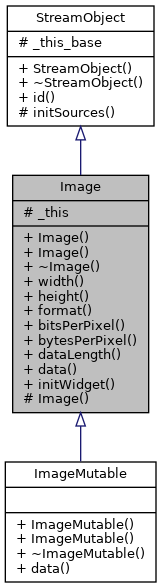
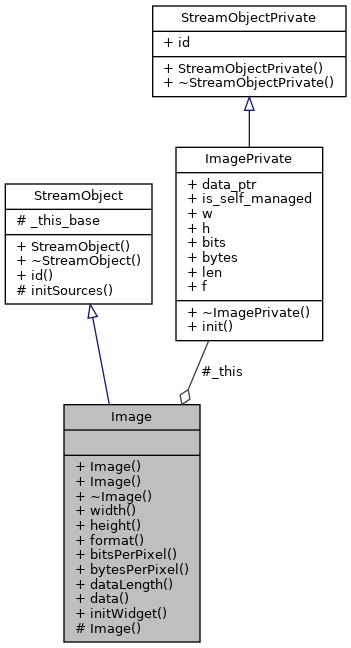
Public Types | |
| enum | Format { NoFormat, RGB555, RGB888, Gray8, YUV422, YUV422_Flipped, BGR_CV } |
| Enum of all supported image formats. | |
Public Member Functions | |
| Image (const StreamObject &base) | |
| Converts a StreamObject to an Image. More... | |
| Image (std::initializer_list< SourceID > sources={}) | |
| Standard constructor. More... | |
| int | width (void) const |
| int | height (void) const |
| enum Format | format (void) const |
| int | bitsPerPixel (void) const |
| int | bytesPerPixel (void) const |
| int | dataLength (void) const |
| const unsigned char * | data (void) const |
 Public Member Functions inherited from StreamObject Public Member Functions inherited from StreamObject | |
| SourceID | id (void) const |
| Get the SourceID of the object. More... | |
Static Public Member Functions | |
| static StreamWidget * | initWidget (OutputPrivate *out) |
| initWidget Returns a ImageWidget to display the image More... | |
Protected Member Functions | |
| Image (bool do_init, std::initializer_list< SourceID > sources) | |
| Protected Member Functions inherited from StreamObject | |
| void | initSources (std::initializer_list< SourceID > sources={}) |
Protected Attributes | |
| ImagePrivate * | _this |
| Protected Attributes inherited from StreamObject | |
| std::shared_ptr< StreamObjectPrivate > | _this_base |
Detailed Description
A portable image class with smart memory management.
This class is pseudo-const. It can be assigned, but the data cannot be altered. To alter the data of an image, use ImageMutable. If you are done manipulating the pixels, convert it to a Image and pass it to the receiver. The receiver has no way (unless he is really nasty) to go back and alter the data again. This means the image data is protected (and read-only access is thread safe). This prevents that two items that receive the same image manipulate each others data. You can also directly convert Qt images (QImage) and OpenCV images (cv::Mat) to Images.
- See also
- ImageMutable
- ImagePrivate
Constructor & Destructor Documentation
◆ Image() [1/2]
| Image::Image | ( | const StreamObject & | base | ) |
Converts a StreamObject to an Image.
- Parameters
-
base The StreamObject
This is only used internally, a plugin should never need to use that. Only use it if you're absolutely sure the StreamObject is in fact an Image!

◆ Image() [2/2]
| Image::Image | ( | std::initializer_list< SourceID > | sources = {} | ) |
Standard constructor.
- Parameters
-
sources Source tree
Needed by some container classes. Not really useful otherwise.
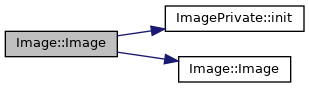
Member Function Documentation
◆ bitsPerPixel()
| int Image::bitsPerPixel | ( | void | ) | const |
- Returns
- The number of bits per pixel (not per channel!)
◆ bytesPerPixel()
| int Image::bytesPerPixel | ( | void | ) | const |
- Returns
- The number of bytes per pixel
◆ data()
| const unsigned char * Image::data | ( | void | ) | const |
- Returns
- A pointer to the pixel data
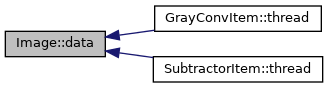
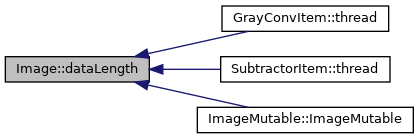
◆ dataLength()
| int Image::dataLength | ( | void | ) | const |
- Returns
- The lenght of the pixel data in bytes
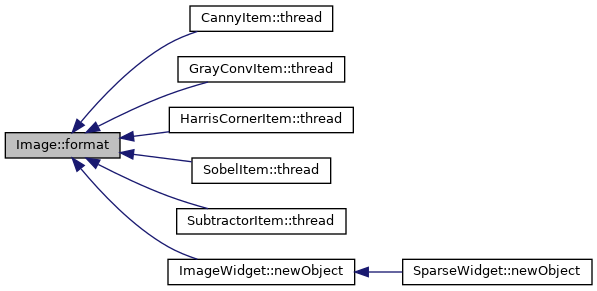
◆ format()
| Image::Format Image::format | ( | void | ) | const |
- Returns
- The format of the image
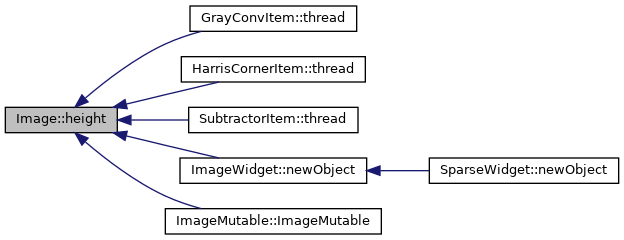
◆ height()
| int Image::height | ( | void | ) | const |
- Returns
- The height of the image
◆ initWidget()
|
static |
initWidget Returns a ImageWidget to display the image
- Parameters
-
stream The asocciated stream
- Returns
- The QWidget to show
See 'How to create your own streams'
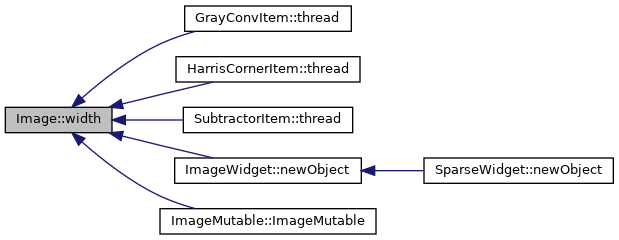
◆ width()
| int Image::width | ( | void | ) | const |
- Returns
- The width of the image
The documentation for this class was generated from the following files:
- usercore/include/streams/image.h
- usercore/src/streams/image.cpp